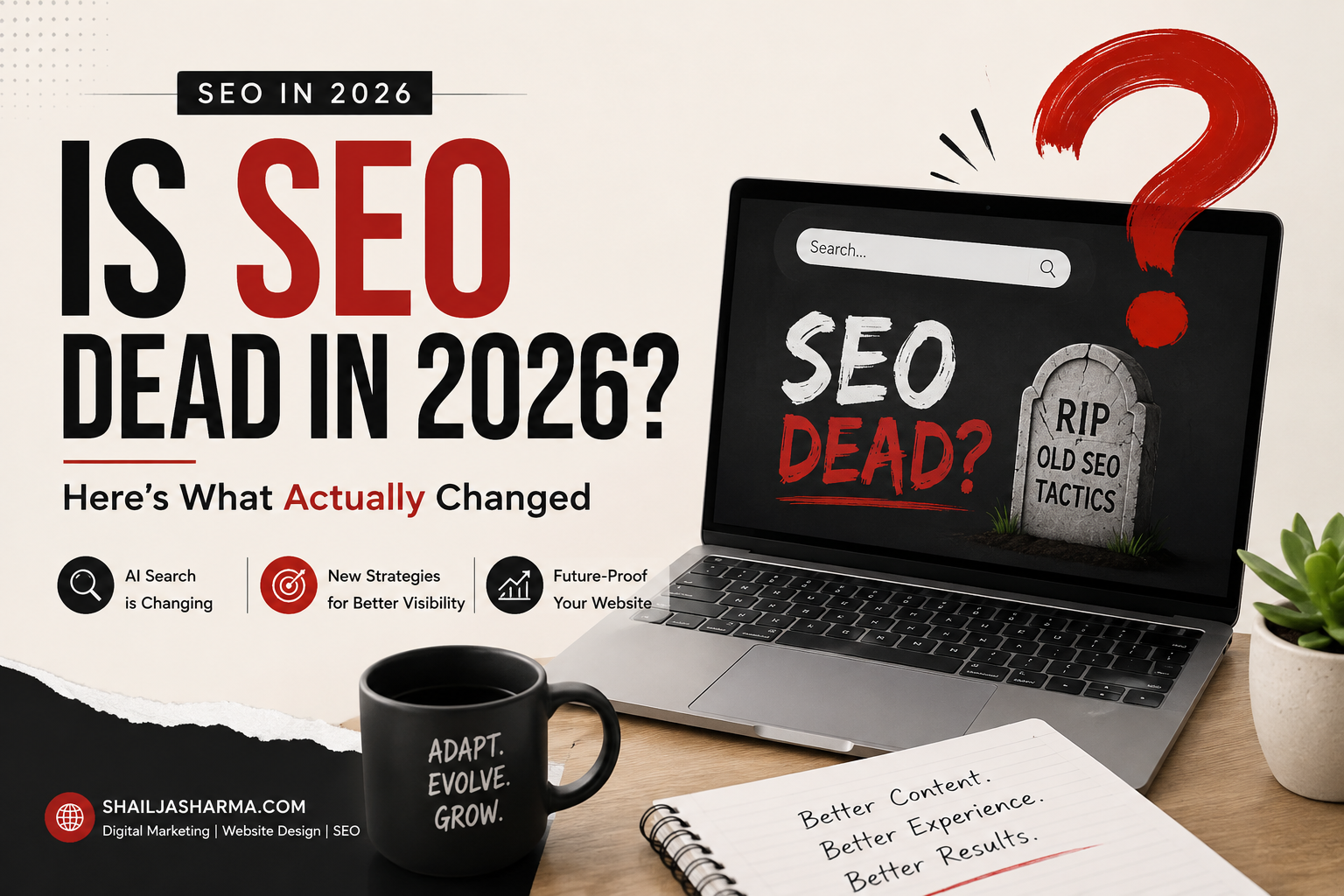
SEO is not dead in 2026. But the way we do SEO has changed.
For years, businesses have relied on search engine optimization to bring visitors to their websites. But with AI-powered search, Google AI Overviews, conversational search, and changing user behavior, many business owners and marketers are asking the same question:
Is SEO still worth it in 2026?
The short answer is yes—but traditional SEO alone is no longer enough.
Google’s current guidance confirms that SEO best practices remain relevant for its generative AI search experiences. The foundation is still helping search engines discover, understand, and evaluate useful content.
So, what actually changed?
SEO Has Evolved, Not Disappeared
SEO used to be heavily focused on ranking a webpage for a particular keyword.
You would research a keyword, place it in your title, headings, URL, meta description and content, build backlinks, and wait for Google to rank the page.
Those fundamentals still matter, but search has become much more sophisticated.
People no longer search only with short phrases such as:
“SEO services India”
They increasingly ask complete questions such as:
“How can I improve my website ranking without spending money on ads?”
AI-powered search experiences can then provide more detailed answers and connect users with relevant websites.
Google says its AI search experiences continue to rely on its core Search systems and index. That means strong technical SEO and valuable content remain important foundations.
1. Keywords Still Matter—But Search Intent Matters More
One of the biggest changes in modern SEO is the shift from simply targeting keywords to understanding search intent.
Search intent means understanding what someone actually wants when they type a query into Google.
For example, someone searching:
“best website designer for small business”
may be looking for a service.
Someone searching:
“how to design a business website”
is probably looking for information.
These two searches may contain similar words, but the user’s goals are completely different.
A successful SEO strategy should therefore focus on answering the question behind the keyword.
Don’t write an article simply because a keyword has search volume.
Write it because you can provide a genuinely useful answer.
2. Helpful Content Is More Important Than Keyword Stuffing
The days of repeating a keyword dozens of times are long gone.
Google explicitly advises against keyword stuffing and says content should be useful, well-organized, unique, reliable and created for people.
For example, instead of repeatedly writing:
“best SEO specialist, SEO specialist India, freelance SEO specialist, SEO expert…”
you should naturally explain:
- What the reader’s problem is
- Why it happens
- What they can do about it
- Which mistakes to avoid
- What results they can realistically expect
Your keywords should support the article—not control it.
This is especially important for businesses using digital marketing to build long-term visibility.
3. AI Has Changed Search
AI is probably the biggest reason people believe SEO is dead.
Google now has generative AI experiences that can answer increasingly complex queries. Users can ask follow-up questions and explore topics in a conversational way.
This changes the goal of SEO.
Previously, the main goal was often:
“How do I get position #1?”
Today, a better question is:
“How do I create content that deserves to be discovered, referenced, and trusted?”
That requires original information, practical experience, useful examples, and clear explanations.
Google’s 2026 guidance specifically emphasizes valuable, unique, non-commodity content rather than content that repeats information already available online.
4. AI-Generated Content Doesn’t Automatically Mean Better SEO
AI can be extremely useful for brainstorming, research, and organizing ideas.
But publishing hundreds of AI-generated articles with little originality is not a sustainable SEO strategy.
Google says generative AI can be useful when researching or structuring content, but generating many pages without adding value can fall under its spam policies.
The better approach is:
AI + Human Expertise = Better Content
Use AI to speed up the process.
Use your own knowledge, experience, examples, and perspective to make the content valuable.
This is particularly important for freelancers, website designers, digital marketers, and business owners who want their websites to build trust—not simply attract clicks.
5. Technical SEO Still Matters
With all the attention around AI, it can be easy to forget the basics.
Your website still needs to be technically accessible to search engines.
Google recommends making sure your pages can be crawled, indexed and understood. Website structure, descriptive URLs, internal links, page experience and accessible content all remain important.
A beautiful website that search engines cannot properly understand can struggle to generate organic traffic.
That’s why website design and SEO should work together.
Good design attracts people.
Good SEO helps them discover you.
Good content gives them a reason to stay.
6. Local SEO Is Still a Major Opportunity
For small businesses, local SEO remains extremely valuable.
If someone searches for a service in their area, they are often much closer to deciding someone performing a general informational search.
Businesses should therefore pay attention to:
- Google Business Profile
- Local keywords
- Accurate business information
- Reviews
- Location-specific pages
- Helpful local content
- Consistent business information
If you are a digital marketing freelancer, website designer or SEO professional serving a particular location, local search can also help you attract highly relevant leads.
7. Backlinks Still Have a Place—but Quality Matters
Backlinks remain part of the wider SEO ecosystem, but chasing hundreds of low-quality links isn’t the goal.
A useful link from a relevant, trustworthy website can provide more value than a large collection of unrelated links.
Instead of asking:
“How many backlinks can I get?”
ask:
“Why would another website want to reference my content?”
That question naturally leads you toward better content, research, original insights and useful resources.
8. SEO Is Becoming More About Brand Authority
One of the biggest opportunities in 2026 is building a recognizable online presence.
Imagine someone repeatedly sees your:
- Website
- Blog articles
- LinkedIn posts
- Helpful guides
- Case studies
- Social content
Over time, you become more than another search result.
You become a recognizable source.
For a freelance SEO specialist, digital marketing freelancer, website designer, or consultant, this can be extremely powerful.
SEO can bring people to your website.
Your expertise and brand can convince them to stay.
So, Is SEO Dead in 2026?
No.
But outdated SEO thinking is becoming less effective.
SEO is moving away from simply manipulating rankings and toward creating a complete search experience.
The future belongs to websites that combine:
Technical SEO + Helpful Content + User Experience + Original Expertise + Strong Brand Presence
Google’s latest guidance makes this clear: its generative AI search experiences still rely on core Search systems, while valuable, original and people-first content remains important.
So don’t abandon SEO because AI has arrived.
Upgrade your SEO strategy because AI has arrived.
Instead of creating content only for search engines, create content that genuinely helps people.
Instead of obsessing over one keyword, understand the questions your audience is asking.
Instead of publishing more, focus on publishing better.
And instead of chasing every new SEO “hack,” build something that lasts: a useful website, a trustworthy brand, and content that demonstrates real expertise.
Final Thought
SEO isn’t disappearing.
Search is evolving.
And businesses that understand that difference will be better positioned to grow online in 2026 and beyond.
The question isn’t whether you should continue doing SEO.
The better question is:
“Is my SEO strategy ready for the way people search today?”
One Comment