You search “how to learn digital marketing” and suddenly you have 100 tabs open.
SEO.
Instagram marketing.
Google Ads.
Content marketing.
Email marketing.
Analytics.
AI tools.
And somewhere between all those tutorials, you start wondering:
“Where am I actually supposed to begin?”
I understand that feeling.
Digital marketing looks complicated when you look at everything at once. But you don’t need to learn everything on day one.
You need a roadmap.
After working with websites, SEO, content and digital marketing, I’ve learned that the best way to learn isn’t to collect hundreds of tutorials.
It’s to learn one skill, practice it, and then build on it.
So if you’re wondering how to learn digital marketing from scratch, here’s a practical place to start.
Step 1: Understand the Digital Marketing Basics
Before opening an SEO tool or creating your first Instagram campaign, understand what digital marketing actually means.
At its simplest, digital marketing is about using online channels to reach the right people and turn attention into meaningful actions—such as visits, enquiries, sign-ups or sales.
Start by understanding the major areas:
- Search Engine Optimization (SEO)
- Content marketing
- Social media marketing
- Email marketing
- Paid advertising
- Website and conversion optimization
- Analytics
You don’t need to become an expert in all of them immediately.
You just need to understand how they connect.
Step 2: Learn How Websites and SEO Work
If you want to build a strong foundation in digital marketing, don’t skip websites.
Your website is often the place where your marketing efforts eventually lead.
This is where learning website designing can become useful.
You don’t necessarily need to become a developer. But understanding how websites are structured, how users navigate them, and how search engines discover pages will make many other digital marketing concepts easier to understand.
Then start learning SEO.
Understand things like:
- Keywords and search intent
- On-page SEO
- Internal linking
- Meta titles and descriptions
- Technical SEO basics
- Content optimization
- Search Console and analytics
And don’t just memorize definitions.
Create a small website or blog and actually experiment.
That’s where learning starts to become a skill.
Step 3: Learn Content Marketing
You can have a beautiful website and still struggle to attract people if you have nothing useful to say.
That’s where content comes in.
Learn how to create content that answers real questions people are searching for.
As a content writer, you should learn more than just writing grammatically correct sentences.
Learn to ask:
Who am I writing for?
Problem are they trying to solve?
What would make them click?
What would make them keep reading?
This way, content becomes part of your marketing strategy rather than just another blog post.
Step 4: Understand Social Media Marketing
Next, learn how businesses use platforms such as Instagram, LinkedIn, Pinterest and Facebook.
Don’t focus only on getting likes.
Learn about:
- Content strategy
- Audience research
- Engagement
- Social media optimization
- Analytics
- Different content formats
- Building a consistent brand presence
And remember: every platform works differently.
What works on Instagram may not work the same way on LinkedIn.
Step 5: Start Using AI as a Tool
You don’t need to fear AI, but you also shouldn’t let it do all your thinking.
Use AI to speed up tasks such as brainstorming ideas, researching topics, creating outlines, analyzing content or repurposing posts.
But your experience, judgment and understanding of the audience still matter.
The goal isn’t:
“Let AI do my digital marketing.”
It’s:
“Let AI help me do better digital marketing.”
Step 6: Practice Before You Feel Ready
This is probably the step beginners skip the most.
They keep watching courses.
Save tutorials.
They make notes.
But they don’t actually practice.
Don’t wait until you know everything.
Create a small project.
Start a blog.
Optimize a page.
Create a social media content plan.
Write an SEO-focused article.
Analyze its performance.
Try again.
If you’re eventually interested in becoming a digital marketing freelancer, practical experience will become much more valuable than simply saying you’ve completed ten courses.
Can You Learn Digital Marketing Without a Degree?
Yes.
A degree can be useful in many careers, but digital marketing is a skill-driven field where practical knowledge matters enormously.
You can learn through courses, books, free resources, projects, internships, freelancing and hands-on practice.
What matters is whether you can actually apply what you’ve learned.
And if you want to become a freelance SEO specialist, for example, clients will ultimately care about whether you understand SEO and can help them—not simply how many certificates you have.
How Long Does It Take to Learn Digital Marketing?
There isn’t one fixed answer.
You can learn the fundamentals relatively quickly, but becoming genuinely comfortable with digital marketing takes practice.
Think of it less like finishing a textbook and more like learning a language.
You don’t become fluent by studying vocabulary once.
You use it repeatedly.
The same is true here.
Learn → Practice → Make mistakes → Improve → Repeat.
You Don’t Need to Learn Everything at Once
If you’re feeling overwhelmed, simplify it.
Start with:
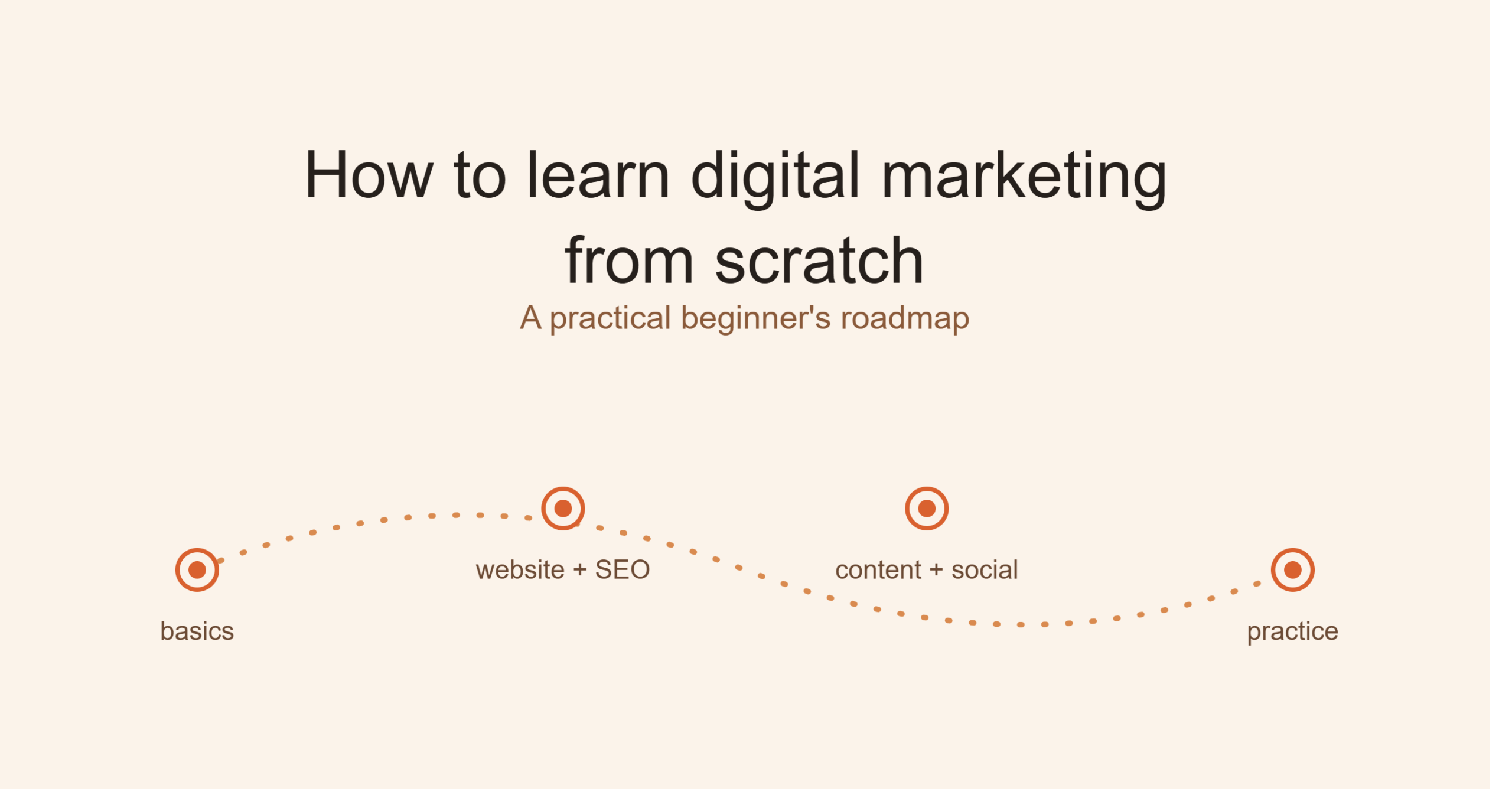
Digital marketing basics → Website → SEO → Content → Social media → Analytics → AI → Practical projects
Then go deeper into the areas you enjoy most.
Some people discover they love SEO.
Others enjoy content, social media, design or paid advertising.
And some eventually combine several skills and work as a digital marketing freelancer.
There is no single “perfect” path.
The important thing is to start.
Want to Learn Digital Marketing Step by Step?
If you’ve been searching for online digital marketing classes because you want more structure than jumping between random videos and tutorials, practical guidance can make the learning process much easier.
I teach digital marketing with a focus on understanding the concepts and learning how to apply them in real situations.
Because ultimately, the goal isn’t just to say:
“I learned digital marketing.”
The goal is to be able to say:
“I know how to use it.”
And that’s where the real learning begins.